

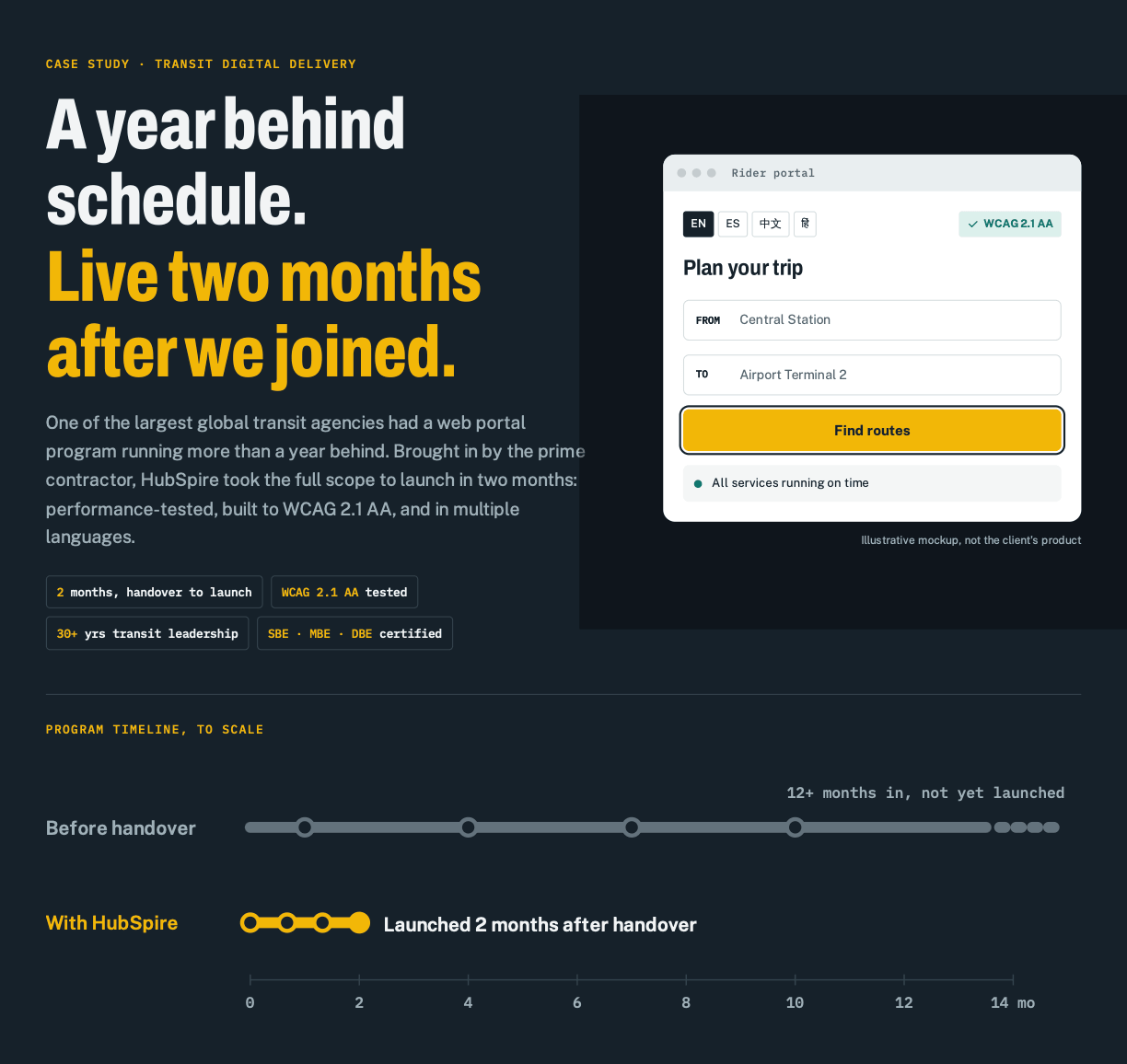
The challenge
The agency needed customer-facing and corporate web portals for a large, multilingual rider base. More than a year in, the program had not launched. The prime contractor needed a partner who could take over mid-flight, understand transit quickly, and deliver without cutting corners on performance, accessibility, or security.
The outcome
HubSpire took over the full scope and launched in two months. The portals were performance-tested before go-live, built and tested to WCAG 2.1 AA, and handed over with content the agency’s own staff manage in several languages.
Our approach
Transit know-how, AI speed, quality you can audit
-

Transit expertise first
Founded by a former New York City Transit bus driver who went on to lead technology initiatives at the MTA. We speak the agency’s language, which cuts weeks of back-and-forth.
-

AI-accelerated delivery
AI turns approved designs into front-end screens in hours instead of days. Engineers review every line and focus on logic, integration, and edge cases.
-

Accessibility built in
Automated checks on every change, plus manual keyboard, screen-reader, and contrast testing. Built to WCAG 2.1 AA, not audited at the end.
-

Quality gates on every change
Automated code, accessibility, performance, and security checks on every update, then sign-off by a named engineer.
-

Weekly demos
The agency and prime saw working software every week, not status reports.
How we deliver
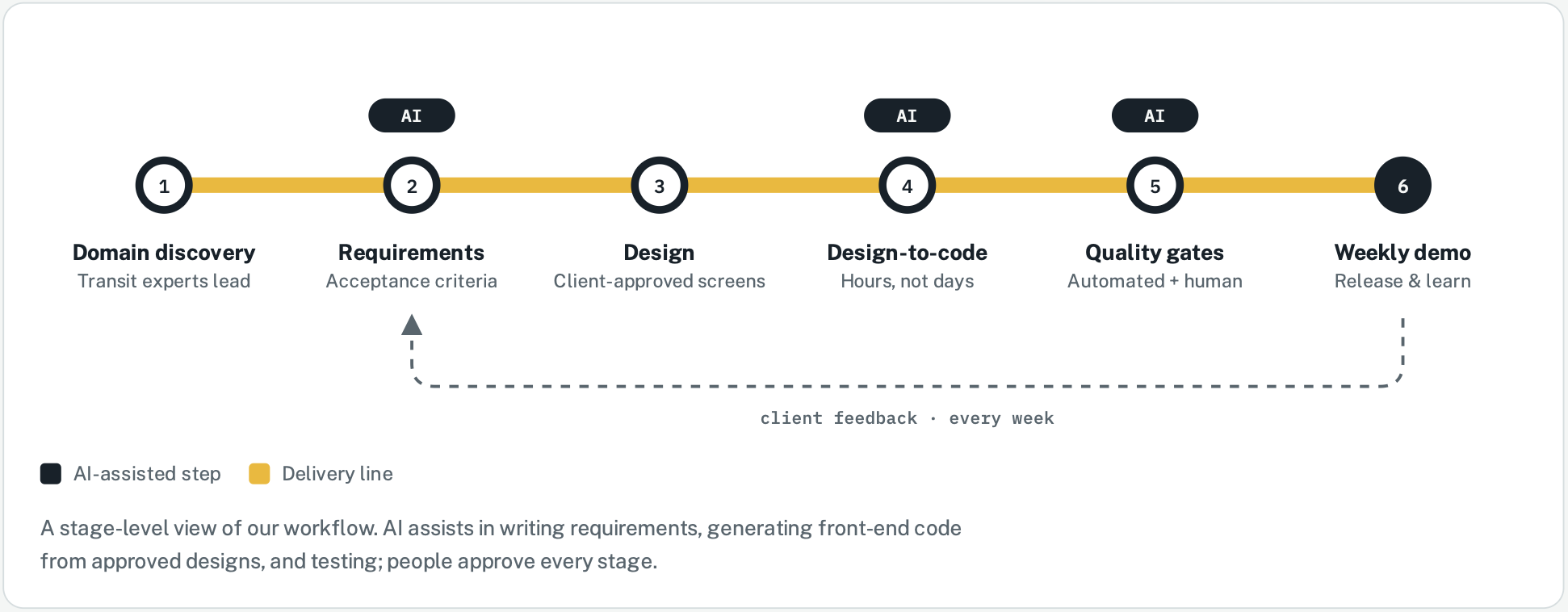
Six stops, weekly loops
Every cycle runs from transit discovery to a live demo, and the client’s feedback feeds straight into the next round of requirements.
Built-in quality
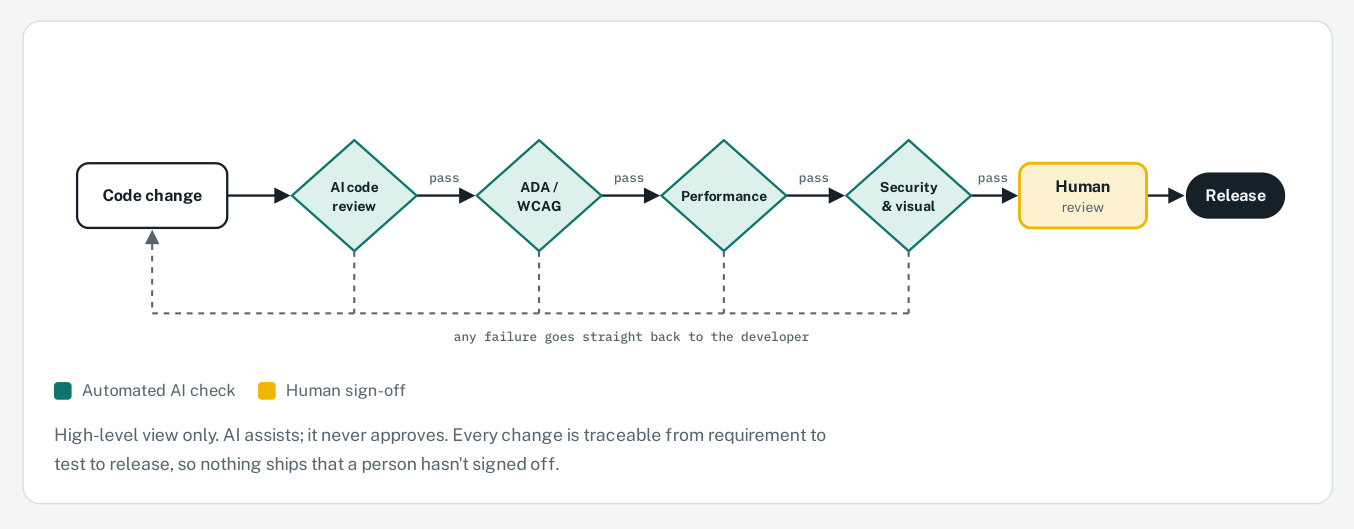
Every change passes four automated gates, then a person
Speed only matters if the result holds up. Nothing reaches the client until it clears accessibility, performance, and security checks and a named engineer signs off.
Results
What the agency got
| Area | Result |
|---|---|
| Delivery | Launched 2 months after handover, on a program 12+ months in |
| Accessibility | Built and tested to WCAG 2.1 AA (automated and manual) |
| Performance | Load-tested before go-live; real-user monitoring after |
| Content | Multiple languages, managed by agency staff in the CMS |
| Handover | Documented code the agency owns, on mainstream open-source frameworks |
Proof, not claims
Talk to the client. We’ll arrange it.
The agency’s leadership rated this the best delivery they had seen on the program. Qualified agencies and primes can speak with them directly, under NDA.
- 40–60% Faster project delivery
- 30–45% Faster feature velocity
- 85%+ Automated test coverage
- 90%+ Issues caught before human review
HubSpire-reported averages across AI-assisted engagements. Methodology available on request.
Questions leaders ask us
Fast is only useful if it holds up
The questions agency executives, architects, and primes raise most, answered plainly.
-
Is two months real, or was the scope cut?
We took over the program’s full remaining scope, not a pilot. Speed came from transit know-how, reusable patterns, and AI handling routine UI code, not from dropping requirements.
-
Who is accountable for AI-written code?
A named engineer reviews and approves every change. AI never merges code on its own, and every change traces back to a requirement and a test.
-
Is our data or IP exposed to AI tools?
We use approved enterprise AI tools only. Agency data is never used to train models, and the agency owns all code and deliverables.
-
Will it fit our existing systems?
The portals connect to agency systems through a clean API layer. Back-office and fare systems stay untouched and can change independently.
-
How is it secured?
SOC 2-aligned engineering: security scans on every change, multi-factor authentication, and encryption in transit and at rest.
-
How do you prove accessibility?
Automated checks on every build, plus manual testing with keyboards and screen readers. Results are documented against WCAG 2.1 AA.
-
What happens after launch?
Documented code on mainstream open-source frameworks, a CMS your staff already use, and a clean handover. No proprietary lock-in.
-
Can a prime rely on you as a sub?
Yes. We have delivered under major primes, and our SBE, MBE, and DBE certifications support subcontracting participation goals.
- Transit clients include MTA New York City Transit, SEPTA and MARTA
- Delivering since 2015 · 275+ projects
- Certified SBE · MBE · DBE